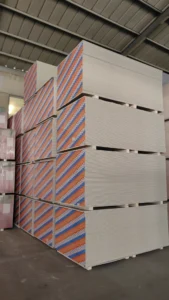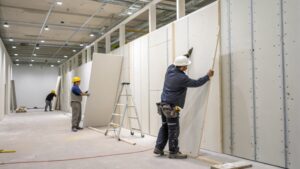


Guyana building code requires fire-rated gypsum board for public spaces including schools, hospitals, government buildings, commercial offices over 500 square meters, and assembly occupancies with capacity exceeding 50 people, following Caribbean Uniform Building Code standards that mandate 1-2 hour fire resistance ratings for egress corridors and occupancy separations.
Public space requirements mandate fire-rated assemblies in schools, hospitals, government buildings, and commercial spaces exceeding 500 square meters. Caribbean Uniform Building Code provides regulatory framework requiring 1-2 hour ratings for corridor walls and occupancy separations. Assembly occupancies with capacity over 50 people require fire-rated construction for egress protection. Code compliance involves tested assemblies using Type X gypsum board meeting ASTM standards. Inspection requirements ensure proper installation and material certification for public safety.
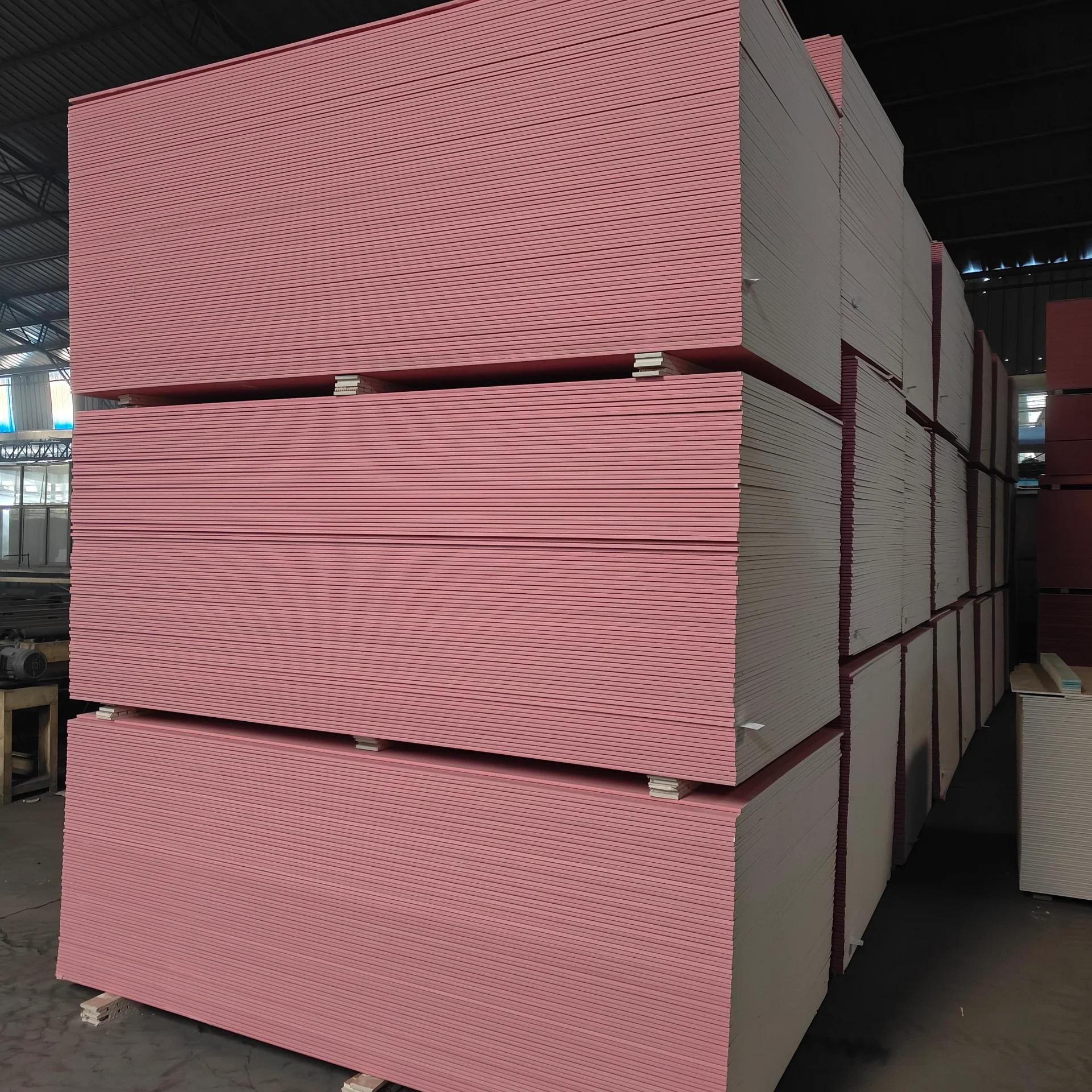
From my extensive experience manufacturing fire-rated building materials, I've observed increasing emphasis on systematic fire protection in Caribbean public buildings following international safety standards.
How Many Hours of Fire Resistance Does 12.5mm Type X Gypsum Board Provide?
12.5mm Type X gypsum board provides approximately 1 hour fire resistance when installed as a single layer on metal studs with proper assembly details, though actual fire rating depends on complete wall system including framing, insulation, fastening patterns, and joint treatment according to tested UL assemblies.
Single layer installation on metal studs typically provides 45-60 minute rating depending on assembly configuration and testing standards. Complete wall systems achieve full 1-hour rating through proper fastening patterns, joint treatment, and tested assemblies. Double layer applications can extend fire resistance to 2+ hours when properly detailed. Assembly variables including stud spacing, insulation type, and screw patterns significantly affect actual performance. Testing standards require full-scale assemblies rather than individual material ratings for code compliance.

Fire Rating Variables
Multiple factors influence actual fire resistance performance of Type X systems.
| Assembly Component | Impact on Rating | Standard Practice | Performance Range | Critical Factors |
|---|---|---|---|---|
| Gypsum Board Thickness | Major | 12.5mm Type X | 45-75 minutes | Core composition |
| Framing System | Significant | Metal studs | ±15 minutes | Thermal bridging |
| Fastener Pattern | Moderate | 12" on center | ±10 minutes | Attachment integrity |
| Joint Treatment | Major | Taped and finished | ±20 minutes | Seal continuity |
| Insulation | Significant | Mineral wool | +15-30 minutes | Thermal barrier |
Joint treatment and gypsum board thickness have the greatest impact on fire rating.
Tested Assembly Ratings
Common Type X gypsum board assemblies and their fire ratings.
| Assembly Description | Fire Rating | UL Design | Installation Cost | Typical Application |
|---|---|---|---|---|
| Single 12.5mm Type X | 45-60 minutes | Various | Baseline | Basic fire separation |
| Double 12.5mm Type X | 120+ minutes | U400 series | +80% | High-risk areas |
| Type X + Mineral Wool | 60-90 minutes | U300 series | +40% | Standard fire walls |
| Type X on Both Sides | 60-120 minutes | U500 series | +60% | Occupancy separation |
| Shaft Wall System | 120+ minutes | U900 series | +150% | Vertical enclosures |
Double layer systems provide significant fire rating improvements.
Performance Standards
International fire testing standards for gypsum board assemblies.
| Testing Standard | Jurisdiction | Test Duration | Acceptance Criteria | Compliance Requirement |
|---|---|---|---|---|
| ASTM E119 | North America | Variable | Structural/thermal | Standard |
| UL 263 | US/Canada | Variable | Fire containment | Common |
| BS 476 | UK/Commonwealth | Variable | Fire resistance | Alternative |
| ISO 834 | International | Variable | Time-temperature | Reference |
| NFPA 251 | Fire protection | Variable | Life safety | Specialized |
ASTM E119 serves as the primary standard for Caribbean applications.
Is Rockwool Insulation Classified as Non-Combustible in Building Fire Tests?
Rockwool insulation is classified as non-combustible in building fire tests, achieving Class A fire rating with zero flame spread and zero smoke development according to ASTM E84 testing, maintaining structural integrity at temperatures exceeding 1000°C while providing thermal barrier that enhances overall fire resistance of wall assemblies.
Non-combustible classification confirmed through ASTM E84 testing showing zero flame spread and zero smoke development. High-temperature stability maintains structural integrity at temperatures exceeding 1000°C without melting or releasing toxic gases. Thermal barrier properties significantly enhance fire resistance when combined with gypsum board assemblies. Class A rating represents highest fire safety classification for building insulation materials. Mineral composition from volcanic rock provides inherent fire resistance without chemical treatments.

Fire Classification Standards
Rockwool performance across different fire testing protocols.
| Test Standard | Classification | Flame Spread | Smoke Development | Temperature Limit | Pass/Fail |
|---|---|---|---|---|---|
| ASTM E84 | Class A | 0-25 | 0-450 | N/A | Pass |
| UL 723 | Non-combustible | 0 | 0-50 | N/A | Pass |
| BS 476-4 | Non-combustible | N/A | N/A | 750°C | Pass |
| ISO 1182 | Non-combustible | N/A | N/A | 750°C | Pass |
| EN 13501-1 | A1 (best) | N/A | N/A | N/A | Pass |
Rockwool consistently achieves the highest fire safety ratings across all major standards.
Performance Characteristics
Detailed analysis of rockwool fire performance properties.
| Property | Performance | Test Method | Significance | Comparison to Alternatives |
|---|---|---|---|---|
| Melting Point | >1000°C | ISO 1182 | Structural integrity | Superior to fiberglass |
| Flame Spread | 0 | ASTM E84 | Fire propagation | Best possible rating |
| Smoke Development | 0-25 | ASTM E84 | Visibility/toxicity | Minimal impact |
| Thermal Conductivity | 0.033-0.040 W/mK | ASTM C518 | Insulation value | Excellent performance |
| Water Resistance | Hydrophobic | ASTM C209 | Moisture protection | Maintains properties |
Zero flame spread and extreme temperature resistance provide superior fire safety.
System Enhancement
Rockwool's contribution to overall fire-rated assembly performance.
| Wall Assembly | Without Rockwool | With Rockwool | Rating Improvement | Cost Impact |
|---|---|---|---|---|
| Single Type X | 45-60 minutes | 60-75 minutes | +25% | +15% |
| Double Type X | 90-120 minutes | 120-150 minutes | +20% | +10% |
| Metal Stud 16" OC | Baseline | Enhanced thermal barrier | +15-30 minutes | +20% |
| Metal Stud 24" OC | Reduced performance | Compensated performance | +20-40 minutes | +25% |
| Shaft Wall | 120+ minutes | 150+ minutes | +15% | +8% |
Rockwool consistently improves fire ratings across all assembly types.
What is the Safest Partition Wall System for Petrol Station Offices?
The safest partition wall system for petrol station offices uses 2-hour fire-rated assemblies with double 15.9mm Type X gypsum board on both sides of metal studs, rockwool insulation core, specialized fire-stop sealants, and compliance with petroleum facility codes requiring separation from fuel dispensing areas and vapor barriers.
2-hour fire rating provides adequate separation from fuel dispensing areas meeting petroleum facility codes for life safety protection. Double Type X layers on both sides create robust fire barrier with enhanced structural integrity during fire exposure. Rockwool insulation adds thermal protection while maintaining non-combustible classification throughout assembly. Fire-stop sealants at penetrations and joints prevent smoke and flame passage maintaining assembly integrity. Vapor barrier integration prevents fuel vapor migration through wall system addressing explosion prevention.
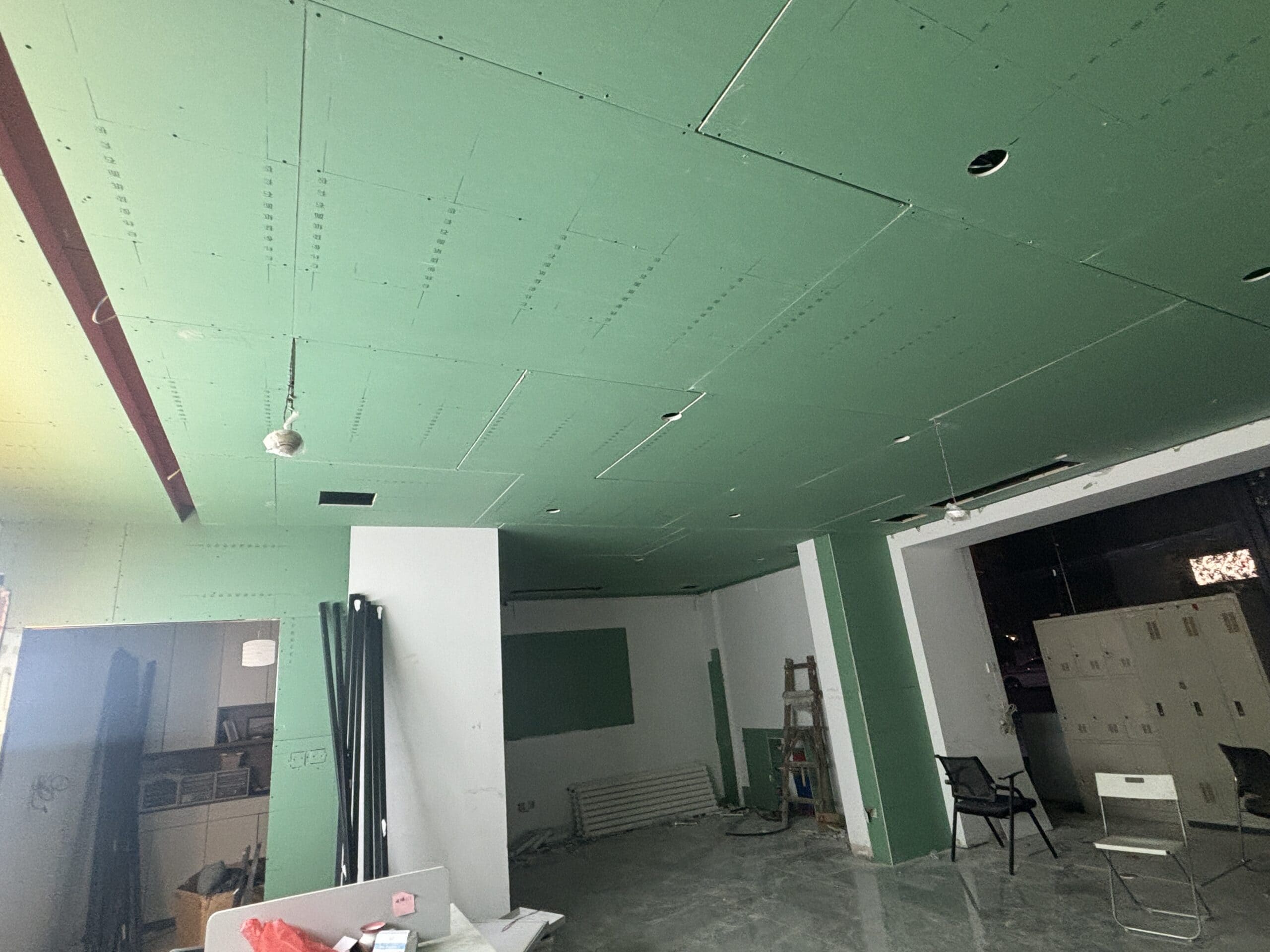
Code Requirements
Specific fire safety requirements for petroleum facility offices.
| Requirement Category | Standard | Specification | Compliance Method | Inspection Required |
|---|---|---|---|---|
| Fire Separation | NFPA 30A | 2-hour minimum | Tested assemblies | Yes |
| Vapor Barrier | IFC | Continuous membrane | Sealed system | Yes |
| Penetration Sealing | UL Systems | Fire-stop rated | Listed materials | Yes |
| Exit Requirements | IBC | Direct to exterior | Protected egress | Yes |
| Ventilation | NFPA 30A | Mechanical system | Explosion-proof | Yes |
2-hour fire rating is the minimum requirement for petroleum facility separation.
Assembly Specifications
Detailed specifications for petrol station office partition walls.
| Component | Specification | Performance | Installation Note | Cost Factor |
|---|---|---|---|---|
| Metal Studs | 25-gauge 6" | Structural support | 16" on center | Baseline |
| Type X Gypsum | 15.9mm double layer | 2+ hour rating | Both sides | +100% |
| Rockwool Insulation | 140mm thickness | Thermal/fire barrier | Full cavity | +25% |
| Vapor Barrier | 6-mil polyethylene | Fuel vapor protection | Continuous seal | +15% |
| Fire Sealant | UL classified | Penetration sealing | All openings | +30% |
| Total System | Complete assembly | Code compliance | Professional install | +170% |
Double Type X layers represent the largest cost component for fire rating.
Safety Considerations
Critical safety factors specific to petroleum facility environments.
| Safety Factor | Risk Level | Mitigation Method | Code Reference | Maintenance Required |
|---|---|---|---|---|
| Fire Spread | High | 2-hour barriers | NFPA 30A | Annual inspection |
| Vapor Migration | High | Sealed barriers | IFC | Quarterly check |
| Explosion Risk | Extreme | Pressure relief | NFPA 68 | Monthly test |
| Egress Protection | High | Protected corridors | IBC | Continuous |
| Emergency Response | Critical | Access provisions | NFPA 1 | Training required |
Vapor migration control requires the most stringent attention and maintenance.
Installation Standards
Professional installation requirements for petroleum facility fire barriers.
| Installation Phase | Standard Requirement | Quality Control | Testing Required | Certification |
|---|---|---|---|---|
| Framing | Plumb and square | Survey verification | Dimensional check | Structural |
| Insulation | Full cavity fill | Visual inspection | Thermal imaging | Energy |
| Gypsum Board | Proper fastening | Screw pattern check | Pull test | Fire rating |
| Vapor Barrier | Continuous seal | Smoke test | Pressure test | Vapor control |
| Final Inspection | Code compliance | Authority review | System test | Occupancy |
Vapor barrier continuity testing is critical for explosion prevention.
Conclusion
Guyana building code requires fire-rated gypsum board for public spaces including schools, hospitals, government buildings, and commercial spaces over 500 square meters following Caribbean Uniform Building Code standards requiring 1-2 hour ratings. 12.5mm Type X gypsum board provides approximately 1 hour fire resistance in proper assemblies with metal studs, though actual ratings depend on complete wall systems including framing, insulation, and installation details. Rockwool insulation is classified non-combustible achieving Class A fire rating with zero flame spread and structural integrity exceeding 1000°C while enhancing overall fire resistance of wall assemblies. Safest partition systems for petrol station offices require 2-hour fire-rated assemblies with double Type X gypsum board, rockwool insulation, fire-stop sealants, and vapor barriers meeting petroleum facility codes. Success with fire-rated systems requires understanding that public spaces mandate tested fire-rated assemblies for life safety, fire ratings depend on complete wall systems rather than individual materials, rockwool provides superior fire performance as non-combustible insulation, and petroleum facilities require enhanced fire separation with vapor control systems, making systematic fire protection design essential for regulatory compliance and occupant safety in public and hazardous occupancy buildings.